 Community Trainings
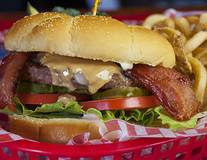 Madison Bear Garden
 Chico Paper Co.
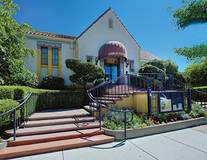 Chico Museum
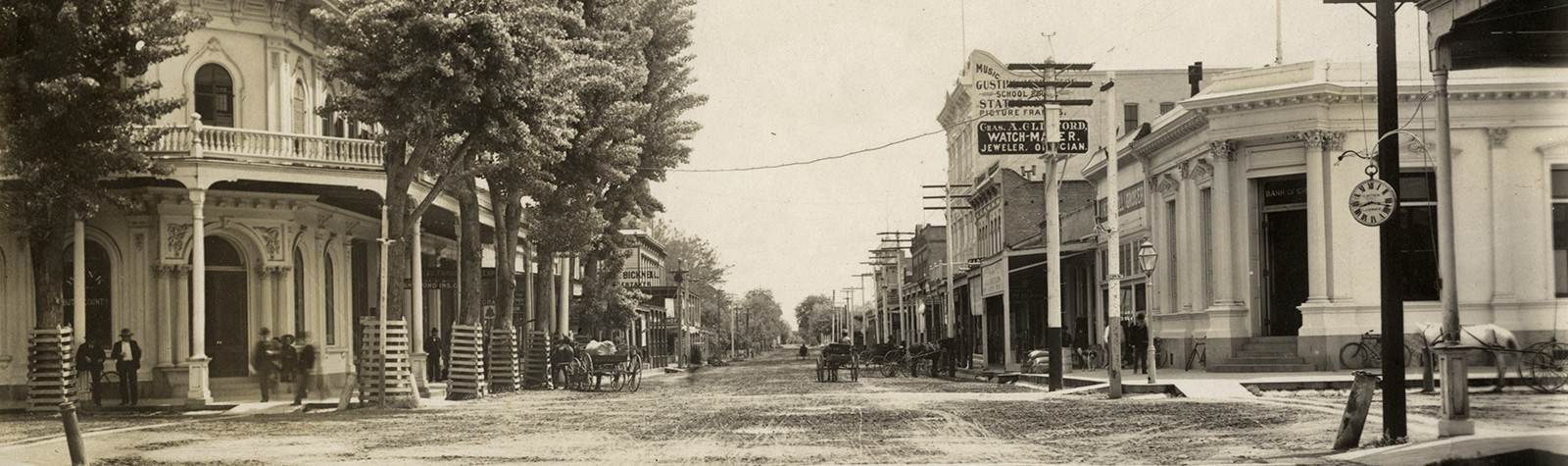 Corner of Broadway & 2nd Streets
History Walking Tour provided by the Chico Heritage Association.
Historic Walking Tour
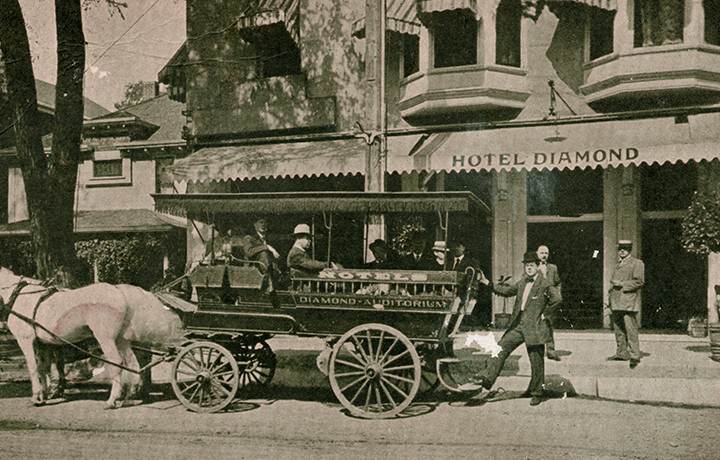 Fourth Street entrance to the Hotel Diamond
The Historic Walking Tour could be completed in about an hour. But with ample opportunity to stop and explore the many shops, or for food and drink at one of the many Downtown Chico restaurants, it would make good use of an entire morning or afternoon. If you decide to take a few detours, this adventure through the history of Downtown Chico could stretch into an entire day.
Begin the tour at the corner of 5th & Main Streets
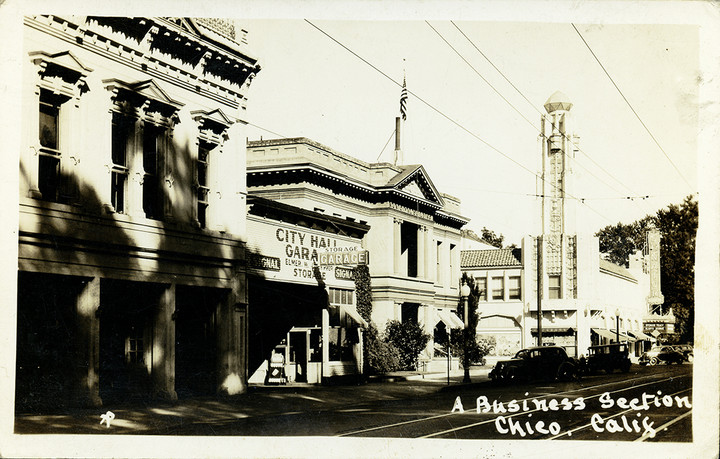 The Municipal building is just right of center. The City Hall garage and the fire station, north along Main have been torn down and replaced by the city council building. The tower of the Senator Theater building on the southeast corner can be seen in the background.
Walk west along 5th Street to the corner of 5th & Broadway
Begin the walking tour on the steps of the Old Chico Municipal Building. This building was dedicated in 1911. Built at a cost of $55,000, it served as the center for city government for many decades. Eventually the city moved to the new buildings behind and to the north. After being empty for a number of years it underwent a renovation in 2008-9 and now houses the Chico Chamber of commerce as well as offices of the Chico Heritage Association and the Butte County Historical Society. Inside, the restored stairway to the second floor can be seen. This grand staircase leads to additional office space and two restored conference rooms on the second floor.
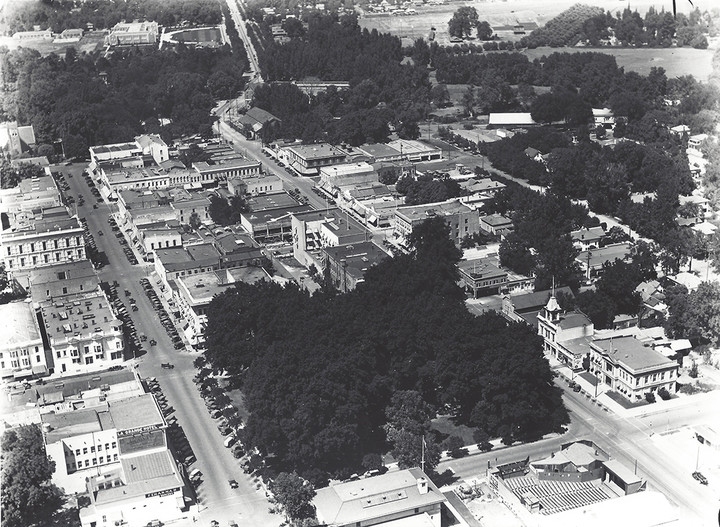 This 1927 photo shows the Plaza and an outdoor movie theater located on the southwest corner of Main and 5th street. Chico residents could enjoy movies here at least during the summer months.
Walk west along 5th Street to the corner of 5th & Broadway
The City Plaza was part of the plan originally laid out by John Bidwell in the 1860's. Bidwell had hopes that Chico would become the County Seat and provision was made for the construction of a building on this parcel if that was to happen. Oroville became the County Seat so the building was never built. The large elm trees shown in the historic photo were victims of age, poor pruning and cultivation practices and were removed when the park was renovated in 2006. Originally the trees in the Plaza as well as those along other downtown streets led Chico to be called a City of Trees. The Plaza now hosts a number of events including popular free concerts on Friday evenings during the summer.
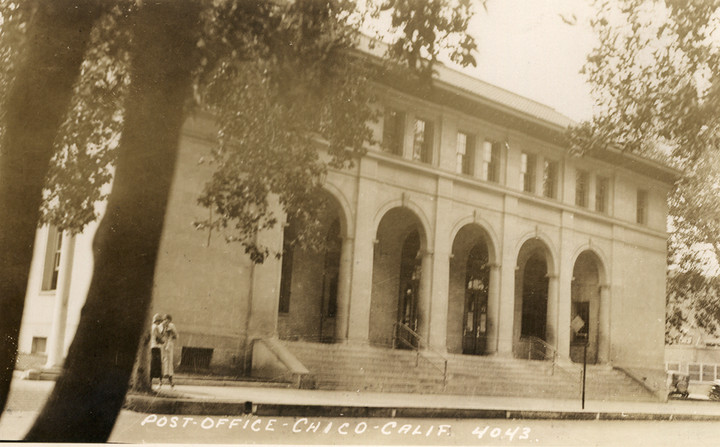 The Post Office building remains basically the same as it was built. The entry doors have been changed and it suffers from some deferred maintenance.
Take Detour #1 to the Junction
Take Detour #2 to Stansbury Home and St. John's Catholic Church
or continue the regular tour...
Walk north along Broadway to the corner of 4th Street & Broadway
The Waterland-Breslauer Building on the northeast corner was completed about 1914. John Waterland, one of those for whom this building was named was in his day a historian for the City of Chico. He was known as "the old timer". Manuel Breslauer was a local businessman who at one was one of the wealthiest and most influential in Chico. The Waterland-Breslauer building has been renovated several times. It now houses the Chico Paper Company as well as other offices and businesses.
This corner was once the site of the Chico Presbyterian Church. The congregation outgrew this church and in 1909 it was replaced by the one on 1st street to be seen later on this tour.
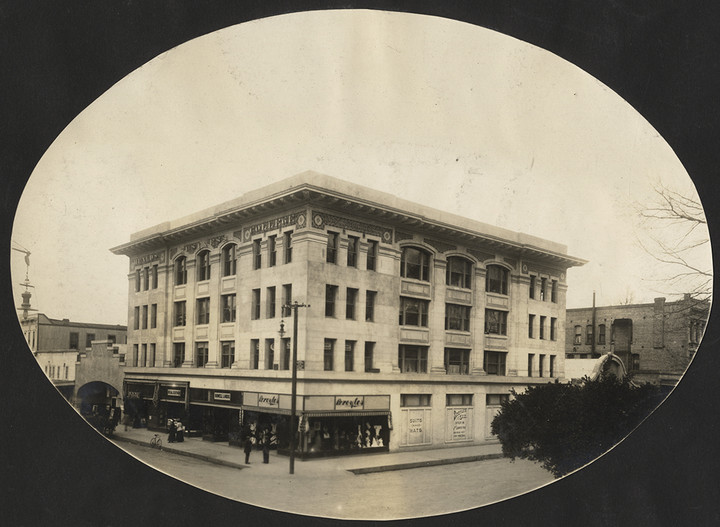 The photo, taken in 1914, shows the Waterland-Breslauer building when it housed the Heald's Business College. Healds occupied the upper floors and a variety of businesses were at street level.
On the Northwest corner of this intersection is the Morehead Building. James Morehead was the original owner of this building and of the Diamond Hotel just down 4th street from it. Compare the historic photo to the current building. The building was "modernized" in the 1940's and the turret and the bay windows removed. Plans are being made to restore some of its original decorative features and to expand the Diamond Hotel into the upper floor.
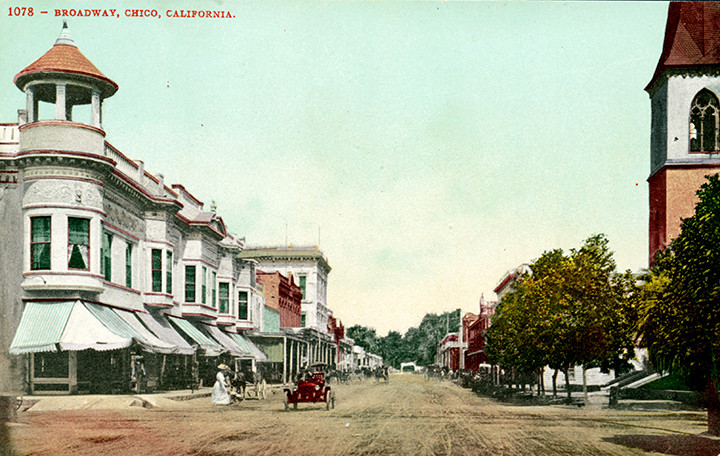 This early 1900 century picture shows the Morehead building with its turret and bay windows. Note the church on the east side of Broadway. This is the Presbyterian Church before it was replaced in 1909.
Looking down 4th street you will see the Diamond Hotel. The hotel was recently renovated after having been allowed to deteriorate to a point were pigeons were the only residents.
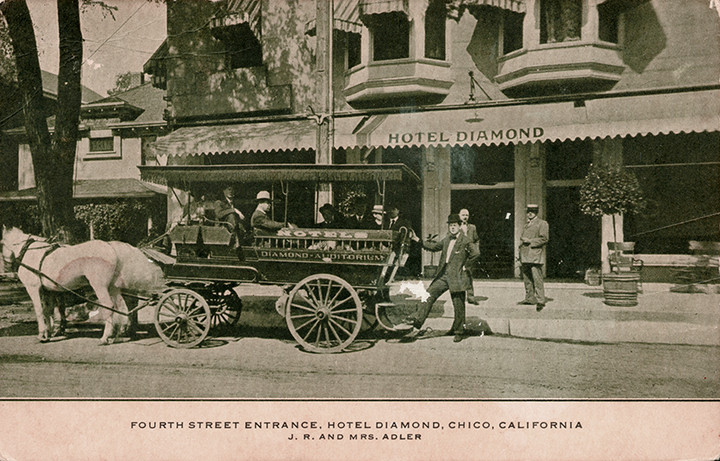 The photo shows the Diamond Hotel in 1908.
Continue walking north along Broadway to corner of 3rd Street & Broadway
The Phoenix Building, on the southwest corner of this intersection was built in 1889 by Jerry Noonan. It has housed a variety of businesses including a meat market and a hardware store. At times it has played a central role in the commercial life of downtown Chico. It was gutted by a fire in 1975. After being rebuilt, it was dubbed The Phoenix Building. The interior is now a small shop mall and is an excellent example of an historic structure saved from destruction by caring owners and tastefully adapted to contemporary use.
The northwest corner of this intersection was for over 100 years the home of Lee Pharmacy. Opened in 1884 by Wesley Lee, it was a leading Chico business and remained a pharmacy until 1994. At the time it closed it was the oldest continually operated pharmacy in the State of California. Starbucks has occupied the location since. The International Order of Odd Fellows, which was responsible for the original construction of the building used the upper floors as its lodge.
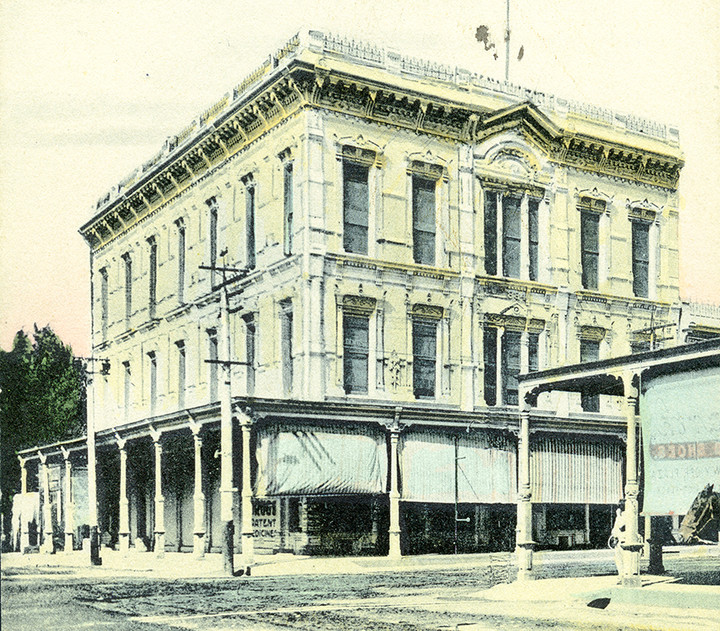 This photo of the IOOF/Lee Pharmacy building was taken before the street was paved. Note that the trim on the building has been removed. During the 1940's and 50's many facades on downtown buildings were “modernized.”
Walk west along 3rd Street to the corner of 3rd Street & Salem
On the north west corner of this intersection is St. Augustine of Canterbury Anglican Church. This was formerly St. John the Evangelist Episcopal Church. The building was originally at the corner of 5th and Broadway, site of the Chico Post Office. It was moved to this location in 1912. In 1982 the building was deconsecrated and spent several years as a Chinese Restaurant. In 1995 it became a church again.
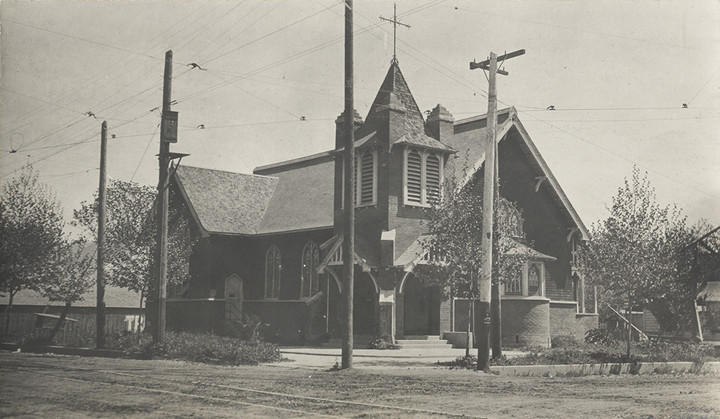 St. Augustine Church before its move to the present location.
Walk north along Salem Street to the corner of 2nd Street & Salem
To the west, the block which is now used as the public parking lot was at one time the site of the Hotel Oaks . This hotel built in 1918, was once the hub of Chico's social scene for residents and visitors alike. It was demolished in 1968, after years of decline due to changing transportation habits.
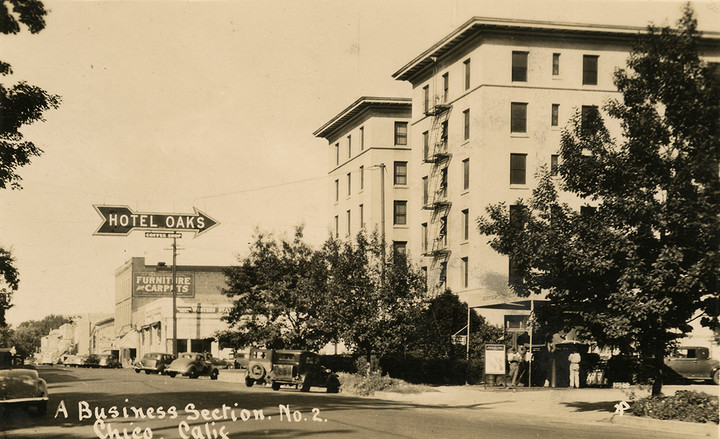 The Hotel Oaks was one of several hotels in the downtown area in the early part of the last century.
Across the street is the building housing the Madison Bear Garden. Now a popular spot for CSU, Chico students, it was built by attorney F. C. Lusk in 1883. This handsome structure was used by Lusk who had a law office on the first floor and residence on the second. Lusk was a prominent citizen in early Chico. A highly successful lawyer, he was active in getting the State Normal School established in Chico and had interests in various banks, including the Bank of Butte County. At his death in 1913, he was estimated to be one of Chico's wealthiest men. The building was owned from 1933 to 1976 by the Native Daughters of the Golden West, who added the pediment-type decoration with a bear motif over the entrance.
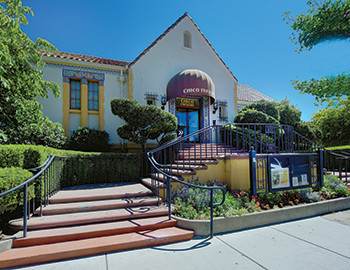
Across Salem Street from Madison Bear Garden is the Chico Museum. This building was originally a Carnegie Library. After the library outgrew the building it was empty for several years before becoming home to the Chico Museum in 1988. The museum houses a permanent display showcasing Chico's history as well as rotating special exhibits.
On 2nd Street next to the museum was the Majestic Theater, now known as the El Rey. This was the first vaudeville theater in Chico and, when first built in 1906, was a fine example of Neo-Classical Revival style. Although the original architectural style has been masked by extensive renovation done in 1948 (due to fire damage in 1946), the structure is still considered historically significant for several reasons. The structure has continuously housed an active theater from1906 to the present. Many older residents still reminisce about evenings spent at The Majestic watching vaudeville or early films. The interior murals by Martin Ravenstein are fine examples of American theater art.
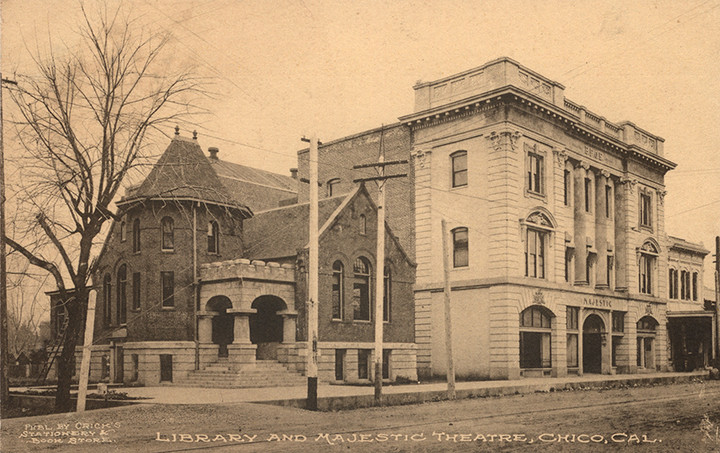 The facades of the Chico Museum and of the El Rey Theater have been significantly altered from those shown in this early 19th century photo.
Continue north along Salem Street to the traffic circle at 1st & Salem Streets
This is an entrance to the CSU, Chico campus. The structure to the north is CSU, Chico's venerable Laxson Auditorium which since its construction in 1931 has been the site of thousands of performances, debates, speeches, graduations, and ceremonies.
Take Detour #3 to the CSU, Chico Campus
or continue with the regular tour...
Walk east along 1st Street to the corner of 1st Street & Broadway
There is a good deal of history associated with this intersection. On the north side of 1st Street is Bidwell Presbyterian Church. The present building was erected in 1909. In 1871 John Bidwell donated sites for several churches is the downtown Chico area. The Presbyterian church was given a site at 4th and Broadway and the original Presbyterian church constructed there with financial help from the Bidwells. By 1909 the congregation had outgrown that site and the lot next to Bidwell's property was purchased and this building erected. Several features from the old church, including the "Bidwell Memorial Window" were incorporated into the new church. The church was extensively renovated in the 1930's following a fire.
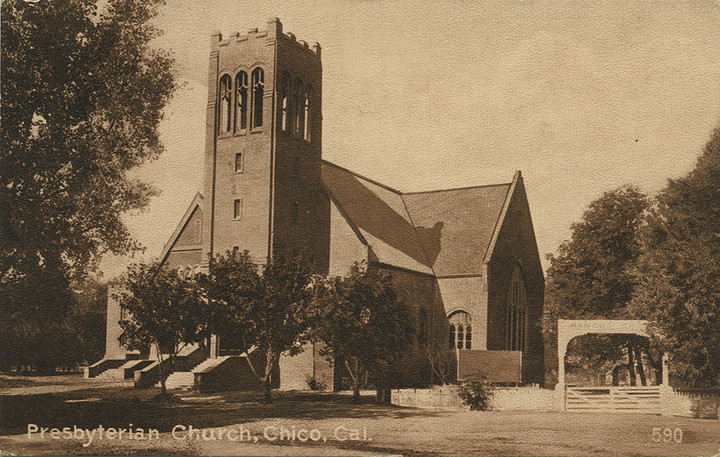 This 1915 photo shows the Presbyterian Church with the gateway to the Bidwell property just to the east.
On the southwest corner of this intersection, now Tres Hombres, a restaurant, was John Bidwell's general store. The building had a second floor and front porch and balcony, now all removed. About the only parts of the original building still identifiable are the windows along the north side. Uses of this site have varied. It was at one time home to the Chico Post Office and at another time to a library. It has survived a number of remodels and a fairly recent nearly disastrous fire.
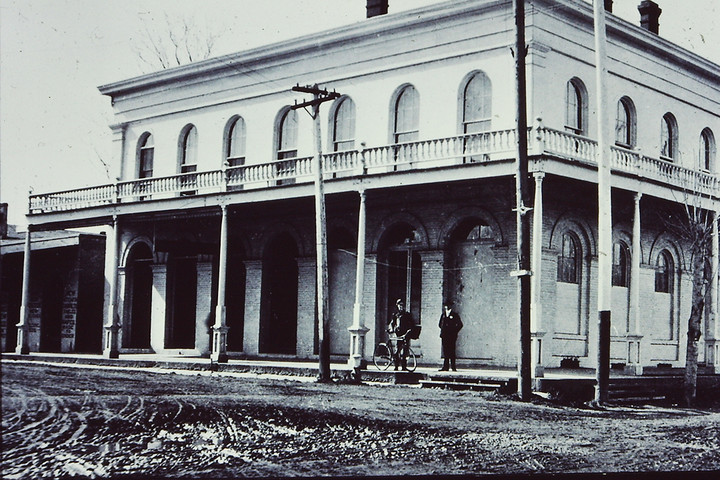 This photo shows the Bidwell Store at a time when there was a second story and balcony and porch surrounding the building. Compare the windows shown in the photo with those still on the north side of the building.
Across Broadway from the Bidwell Store is the building now housing Collier Hardware. This is one of the oldest buildings in downtown Chico. Built in 1871, the lower floor housed The George F. Jones Hardware store and the upper floor was occupied by the Masonic Lodge and the Odd Fellows Lodge. The Odd Fellows lodge (IOOF) moved to the the Corner of 3rd and Broadway in 1884 but the Masonic Lodge continued to use this facility for another century. Except for the period from 1913 to 1915 when the Chico post office occupied the first floor there has been an hardware store almost continuously in this location. It has been known as Collier's since the 1940's though ownership has changed several times.
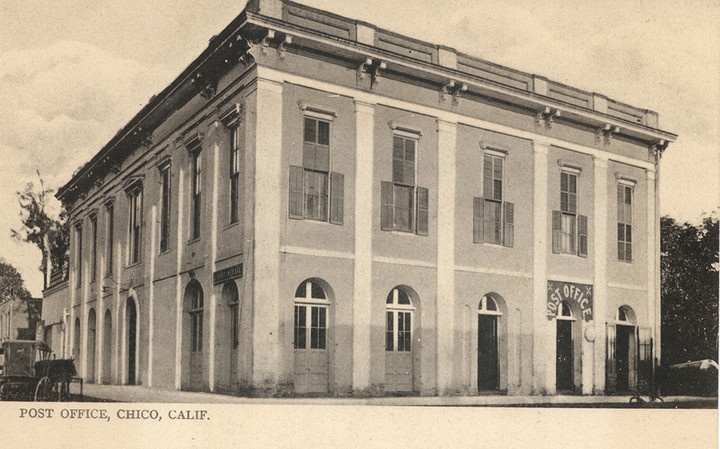 This photo was taken during the time when the Post Office occupied the first floor of what is now Collier's Hardware.
Walk south along Broadway to the corner of 2nd and Broadway
There is a plaque on the sidewalk on the northwest corner of this intersection. It reads Hibbard and Sommer. This was the name of a Jewelry and Stationers Store which at one time occupied this corner. There were two plaques, originally under the store windows. One of them has been preserved in the sidewalk. The plaque is in front the the present Coldstone Creamery.
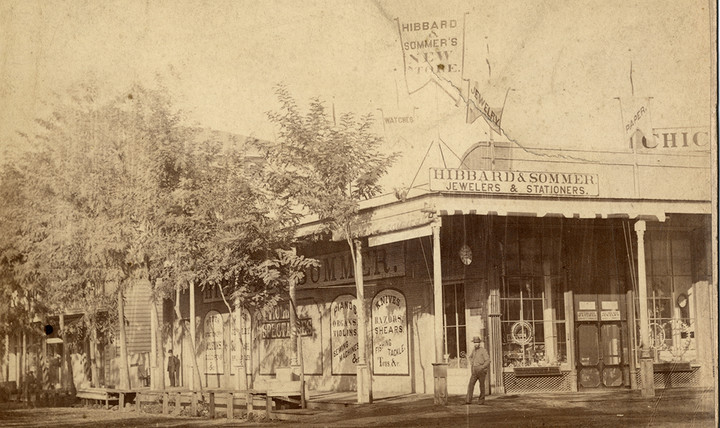 Hibbard & Sommer Jewelry and Stationers were in business in the early 1880's. The building, now housing Coldstone Creamery, has been significantly altered.
For most of the years since the 1860's The two south corners of this intersection have had banks on them. Originally, on the southeast corner was the Bank of Butte County. Bank of Chico occupied the southwest corner. Bank of Butte County became the Bank of Italy and later Bank of America, then First interstate Bank and finally Wells Fargo. The southwest corner underwent similar transformation with a series of banks.
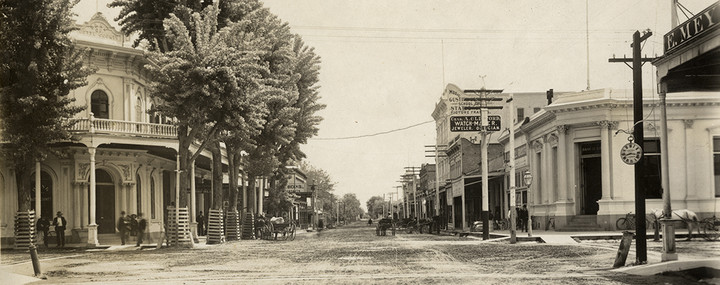 This photo looks south along Broadway. The photo was taken before the streets were paved in about 1911. The sign for Cliffords Jewelry, another long time downtown business, can be seen just above the Bank of Chico.
Walk East along 2nd Street to the corner of 2nd & Main Streets
On the Southwest corner of this intersection was the Graves Drugstore. Built in 1873 after a fire which had destroyed much of the block, this upscale pharmacy advertised drugs, chemicals, patent medicines and toilet articles as well as "Pure wines and liquors" with the understanding that these were to be used for medicinal or communion purposes. Dr. Stansbury, a long time Chico Physician had his early practice here. This corner now houses Zucchini & Vine, Chico's premiere cooking and entertainment store.
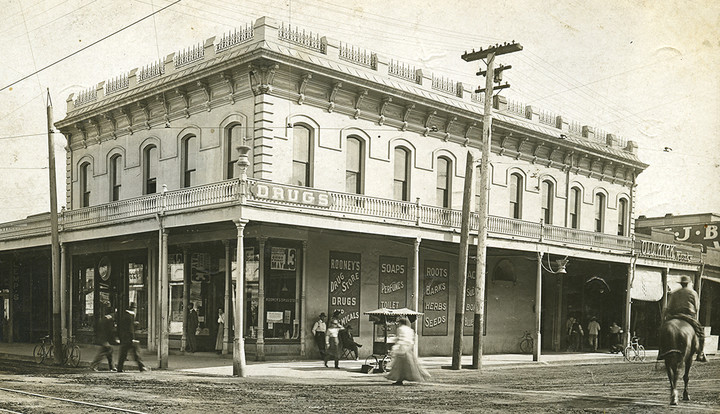 Compare the windows shown in this photo to the present windows. Many details of the building have been changed but the windows have remained the same.
Take Detour #4 north on Main Street to Bidwell Mansion and the Gateway museum
or continue with the regular tour...
Walk South along Main Street Corner of 3rd and Main
The 1927 structure on the northwest corner of this intersection is now called the Grandview building but is known to many as Osers. This location was home to Osers Department Store for many decades until its closure in 1986. The grand central staircase provided generations of Chico residents with an elegant shopping experience.
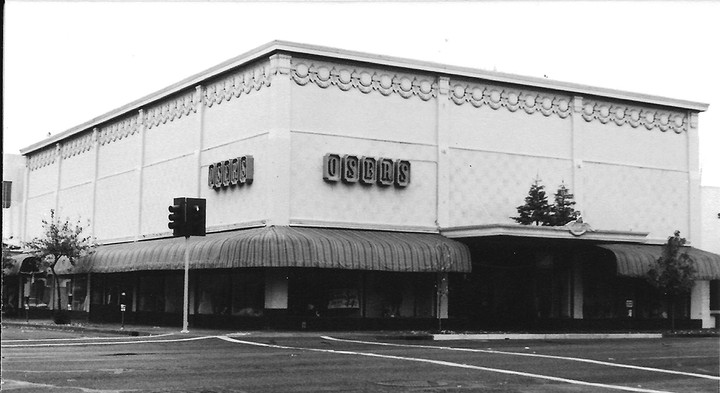 This 1940's era photo of the Grandview Building shows the building when it housed Chico's favorite shopping spot, Osers.
Continue south along Main Street
The first Chico Town hall was situated on the east side of Main Street between 3rd and 4th when Chico was incorporated on January 8, 1872. There is a, somewhat difficult to find, plaque on the east side of Main showing the exact location of this structure.
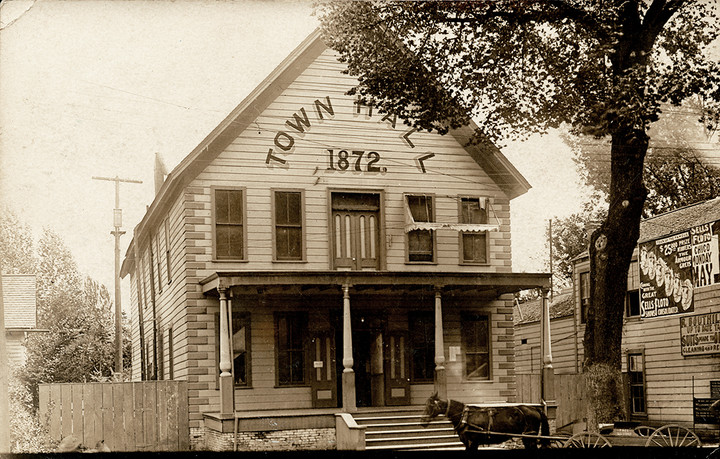 This small wood frame building was the first town hall for the new City of Chico in 1872.
Continue South along Main Street to the corner of 4th & Main Streets
One of the many hotels once prominent downtown Chico, the Park Hotel occupied the southwest corner of this intersection from 1888 until 1963. This hotel overlooked the City Plaza.
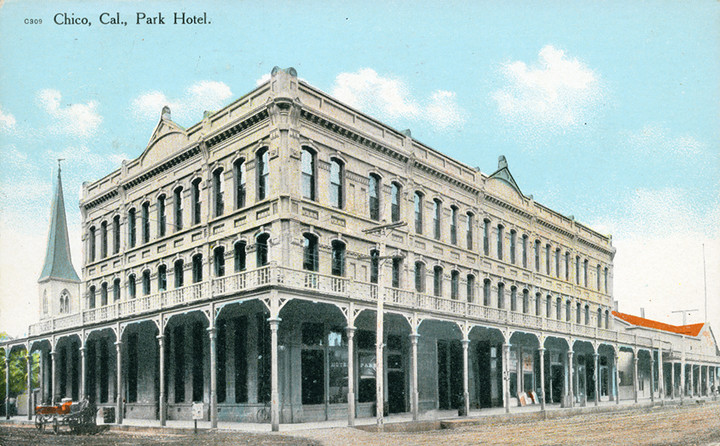 In the historic photo note the tram tracks running along Main Street. Streetcar service was essential in transporting workers to the Diamond Match Factory in the southwest part of town. In the background the steeple of the Presbyterian Church can be seen. This photo was taken before the church was torn down in 1908.
This is the end of the Downtown Chico Historic Walking Tour
Detour #1: The Junction
From the intersection of 5th Street & Broadway walk three blocks south to 8th Street & Broadway
On the south end of town sat "The Junction," where Main and Broadway intersected the Humboldt and Oroville Roads, the two major routes out of town.This area was once a very important one to the Chico area. Called the Junction it was where the main downtown streets intersected with Humboldt Road. When John Bidwell laid out his plans for Chico he had hopes that the Humboldt Road, over which he transported goods would become the major route connecting Northern California with the states to the east of the Sierra's. The Humboldt Road, beginning in Chico, ended in Boise Idaho. Hopes that this would be the major road to the east were dashed when the transcontinental railroad chose the route connecting Sacramento with Nevada over Donner Pass and Bidwell's dream died. This area, never the less was a hub of activity for Chico for much of its early history. Businesses at the Junction included a brewery on the southwest corner of 8th and Broadway one of the only historic buildings still marking this location.
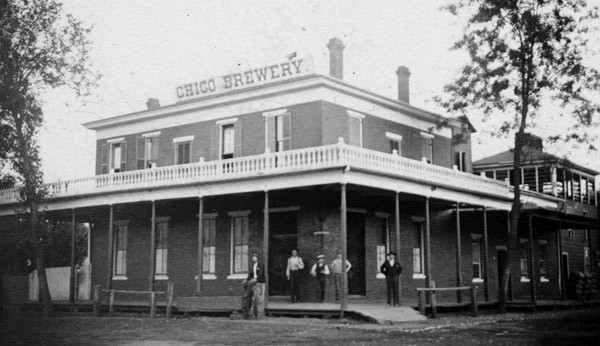 This picture shows the Chico Brewery. Compare it to the present building at the southwest corner of 8th and Broadway
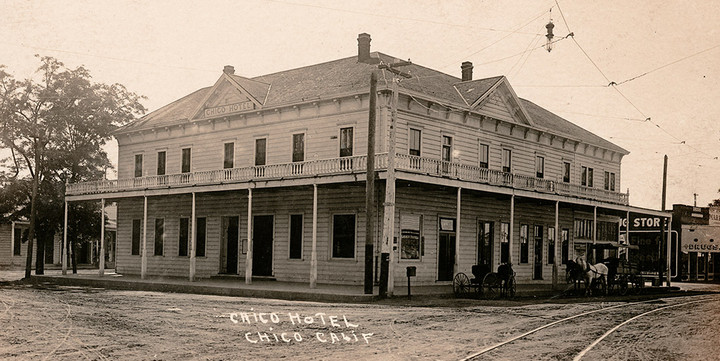 The Chico Hotel was located at the Junction. This building replaced earlier hotels of the same name located elsewhere in the downtown Chico area. It is smaller than the predecessors.
Detour #2: The Stansbury Home and St. John's Catholic Church
From the intersection of 5th Street & Broadway walk west along 5th Sreet
One block west at the intersection of 5th and Salem is the Stansbury Home. This home was built for prominent Chico Physician Oscar Stansbury in 1883 and was occupied by members of his family until it was given the the City of Chico by his daughter Angela Stansbury nearly a century later. The home contains much of the furniture used by the family as well as some of Dr. Stansbury's medical equipment and has original wall coverings. It is maintained by an all volunteer organization and is open to the public most Saturdays and Sundays from 1 to 4 PM and for special events during the year including a Christmas open house and an a ice-cream social held each year in August.
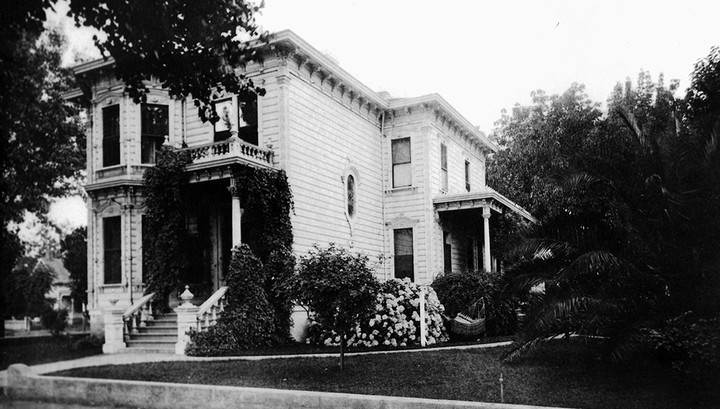 The Stansbury home has remained very much the same as when it was built in 1883.
Walk two blocks to the west and then turn north along Chestnut Street
On the Corner of Chestnut and 4th is St. John's Catholic Church. The Catholic Church as had a congregation in Chico since the first was recognized in 1878. The Cornerstone for the present church was laid in 1908 with the construction completed soon after that time. The present church replaced an earlier smaller, wooden church located on the same property. In 1871 John Bidwell made a gift of property to a number of church groups. St John's is the only of these that continues to occupy the property originally given at that time. St. John's and Norte Dame School are on the square block given to the Catholic congregation by Bidwell.
Detour #3: CSU, Chico Campus
The CSU,Chico campus had its beginnings in 1887 as Chico Normal School on 8 acres of what had been John Bidwell's cherry orchard. The donation of the property was a key factor in the decision to locate the college in Chico rather than in Redding. Through the years the institution has been known as Chico Normal School (1887–1920), Chico State Teachers College (1921–1934), Chico State College (1935–1971) and California State University, Chico (1972–present). The campus now consists of 119 acres and has a student population of more that 16,000.
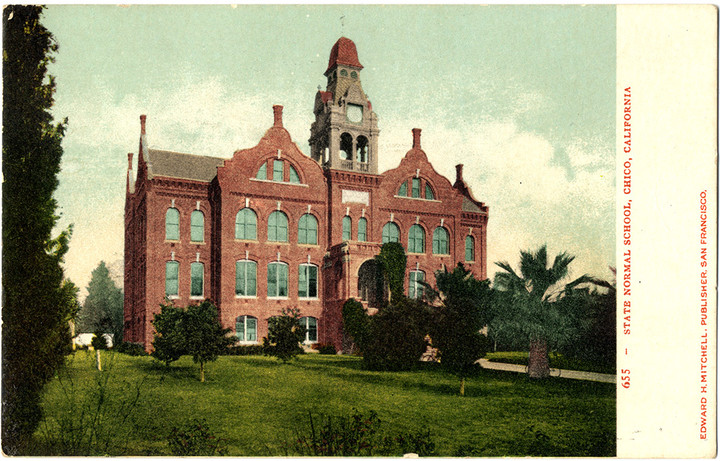 This picture shows the original building of the Chico Normal School. This building was destroyed by a fire in 1927.
Detour #4: Bidwell Mansion and the Gateway Science Museum
No visit to Chico would be complete without a visit to the home of Chico's founder, John Bidwell. John Bidwell had already begun work on his three-story, 26-room mansion on Rancho Chico before he met Annie. San Francisco architect Henry W. Cleaveland designed the grand house. Completed in 1868, it had running water, flush toilets, modern gas lights and an air cooling system. The Bidwells were known for their gracious hospitality and the Mansion was used extensively for the entertainment of friends, family and special guests. Some of the special guests included President and Mrs. Rutherford B. Hayes, General William T. Sherman, Susan B. Anthony, Francis Willard, Governor Leland Stanford, John Muir, Asa Gray, and Sir Joseph Hooker. It was the home of John and Annie for the remainder of their lifetimes. It is now operated as part of the California State Parks System.
Just north of the Mansion is the Gateway Science Museum. Home to permanent and rotating exhibits this is a popular destination for adults as well as children.
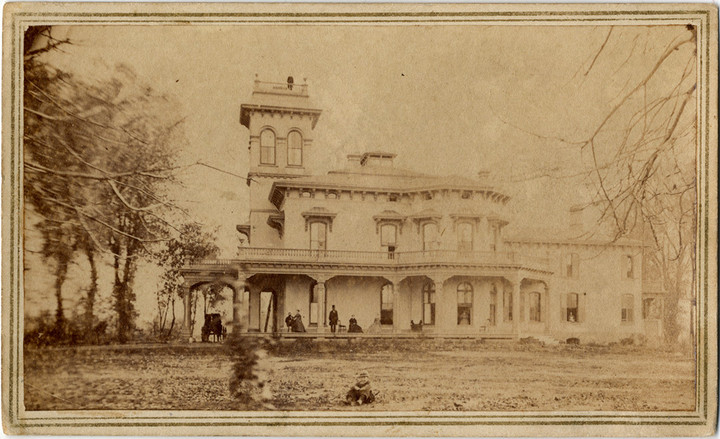 This 1868 photo shows Bidwell Mansion with the Bidwells on the porch and a carriage in front of the home. It was taken shortly after the completion of the mansion.

Upcoming Events